For beginners without experience
No “need to know programming” stuff. The first lesson is from scratch, on the command line.
Cyber Start — a practical course for those who want to enter IT. Linux, networks, web security and your first work on our lab range. No prior experience or formal IT education required.
We start from the terminal and end with a mini-CTF on our lab range. Each lesson is a task that you solve with your hands.
No “need to know programming” stuff. The first lesson is from scratch, on the command line.
For those who choose a profession and want to check that information security is really their topic.
Developers, system administrators and testers who need to understand security more deeply.
A short, focused entry into information security — no fluff and no months of theory.
Two lessons a week for 1.5 hours: the first - basics and demonstration, the second - laboratory with analysis. The final is an individual mini-CTF.
What do specialists protect, what career paths are there, and the rules for working at the test site.
Connection to the laboratory and a simple CTF task. Passwords, MFA and account protection.
Users, access rights and processes are the basis without which not a single task can be completed.
We look for files and artifacts, work with rights, read logs.
How data moves across the network and where it can be seen.
We analyze the network exchange, find DNS requests and suspicious connections.
Open information retrieval, metadata, digital footprint, and the organization's attack surface.
We explore the educational organization and find services for a permitted laboratory purpose.
Requests, forms, cookies and sessions. Basics of SQL injection and XSS.
We find simple vulnerabilities in a training application, explain the consequences and methods of protection.
Signs of phishing and types of malware.
Training letter, headings and URL. Analysis of metadata, strings and hashes of a secure training file.
Updates, least privilege, firewalls and backups. Stages of response.
Based on the logs, we find an attempt to hack an account, compile a chronology and propose protective measures.
We review a demonstration incident and prepare for the final challenge.
Linux, traffic, web and logs. Presentation of results and feedback.
We analyze cryptography through passwords, hashes and HTTPS. Reverse Engineering, difficult operation vulnerabilities and privilege escalation - at the next level: in eight weeks it is more important to consolidate the basics.
You connect to the training laboratory and work on permitted purposes - just like in real information security, but without risk.
The first lesson is the basics and demonstration, the second is practice with analysis of the results.
According to the laboratory results: everyone understands their mistakes and the next step.
Fortinet NSE 1 and Cisco Networking Academy materials parallel to the main program.
FAQ between classes, sharing findings and teacher support.
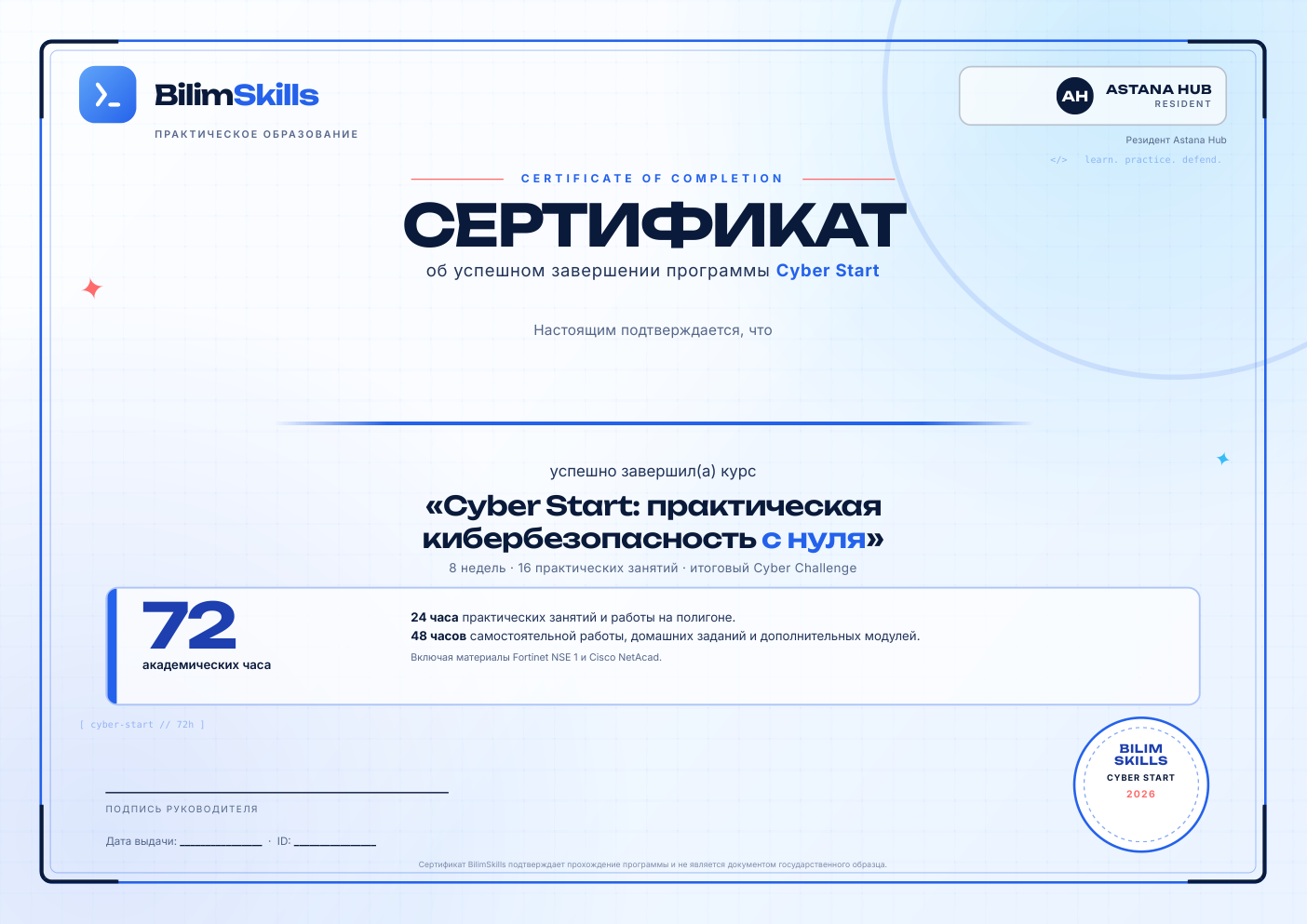
After the final Cyber Challenge - a document that can be attached to the portfolio. View certificate
Before the start of classes, we will send you short instructions on connecting and testing your laptop - the first lesson will not be spent on setup.
After the final Cyber Challenge you receive a personalized certificate. 72 academic hours: 24 hours of practice and 48 hours of self-study, homework and Fortinet NSE 1 / Cisco NetAcad modules.
The image above is a sample. A personalized certificate is prepared after the course and is not a state-recognized document.
Team of teaching practitioners: cybersecurity, networks, architecture and mathematics.
Cybersecurity
TryHackMe PenTest+ · KazHackStan 2026
Information Security Basics
CCSA R81.20 · HCIA-Security
Information Security Basics
AWS CCP · AWS Solutions Architect · OpenEDG Python
Information Security Basics
Associate Certified Electronics Technician
Information Security Basics
Information Security — Coursera
Information Security Basics
Networks and Routing
CCNA · Huawei Datacom · Bolashak
Networks and Routing
Huawei HCIA-Datacom · AWS CCP
Networks and Routing
Huawei HCIA-Datacom
Computer architectures
Computer Architecture — Coursera
Computer architectures
Probability theory
Probability theory
Probability theory
Bolashak alumni
Starts December 7, 2026 · 8 weeks · 16 lessons · 24 hours
Payment - after calling and confirming the place. Leave your contacts and we will tell you the details.
No. The course starts with the very basics: terminal, file system, basic commands. No programming is required - just a computer and the desire to understand.
The course starts on December 7, 2026. Classes are online; we will send the schedule after you apply.
3 hours of classes (2 × 1.5 hours) and 2–3 hours of independent work. This is enough to consolidate the material and not fall out of rhythm.
Classes are held online - live meetings with the teacher. Practice is carried out on our lab range: we provide access to training stands during the course.
This is a training lab range on our infrastructure. You connect to it and complete tasks for authorized training purposes: from the first CTF task to investigating an incident using logs.
Laptop or PC with 8 GB of RAM, stable Internet and browser. We provide everything else - training stands and tools.
Yes, in parallel with the main program, we are reviewing Fortinet NSE 1 and Cisco Networking Academy materials to reinforce topics on networks and security. Full preparation for the CCNA is a separate next course.
Yes. After the final mini-CTF you receive a BilimSkills certificate. This is not a government document, but is a good proof of skills for a portfolio and first interviews.
Apply now and we’ll call you to discuss payment and format. The price is 169 000 ₸ for the entire course.
Warn the curator: we will suggest what to study on your own, and we will look at the missed topic before the next lesson.
We’ll call you back, answer your questions and tell you how the training is going. No spam - just to the point.
Thank you! We will contact you shortly to discuss course details.